


Hermetic Occult Practices and Traditions

Hermeticism is often treated as a single hidden religion, but that is too simple. It is better understood as a living stream of esoteric philosophy, ritual practice, and spiritual symbolism that has flowed through Egyptian, Greek, Jewish, Christian, Islamic, and modern occult traditions.
At its center is a bold idea: the human being can come to know the divine order of reality. Not only through belief, but through contemplation, purification, ritual, symbolic study, and direct inner transformation.
That makes Hermetic occult practices different from many religious systems. They do not always ask for membership in one church, loyalty to one scripture, or worship of one fixed pantheon. Instead, they offer a map of the cosmos and a method for aligning the soul with it.

Hermeticism began as a meeting point of cultures
Hermeticism took shape in the Hellenistic and Roman worlds, especially in and around Alexandria in Egypt. This city was one of the great intellectual centers of the ancient Mediterranean. Greek philosophy, Egyptian temple religion, astrology, medicine, mathematics, and mystery traditions all crossed paths there.
The figure at the heart of the tradition is Hermes Trismegistus, whose name means “Hermes the Thrice-Great.” He is not a normal historical founder in the way the Buddha, Jesus, or Muhammad are historical religious figures. Hermes Trismegistus is a symbolic master, a fusion of the Greek god Hermes and the Egyptian god Thoth.
Hermes was linked with language, travel, mediation, cleverness, and guidance between worlds. Thoth was linked with writing, wisdom, measurement, magic, and sacred knowledge. When these figures merged, they became the ideal source of hidden wisdom.
Several texts became central to the Hermetic tradition. The most famous include:
The Corpus Hermeticum, a collection of philosophical and mystical dialogues
The Asclepius, a Latin Hermetic text that discusses divine images, the cosmos, and spiritual knowledge
Fragments preserved by later writers, especially in late antique, medieval, and Renaissance sources
These texts do not read like a rulebook. They are often dialogues between a teacher and a student. They explore the nature of God, the structure of the universe, the human soul, the powers of the planets, and the path of spiritual rebirth.
The tradition later passed through many hands. Islamic scholars preserved and developed Hermetic ideas in astrology, alchemy, and philosophy. European Renaissance thinkers such as Marsilio Ficino and Giovanni Pico della Mirandola read Hermetic texts as ancient theology. Later occult orders, including the Hermetic Order of the Golden Dawn, reshaped Hermetic material into ceremonial magic.
So the “founding” of Hermeticism was not a single event. It was a long formation, built from many cultures and renewed in many periods.
The core concept is that the cosmos and the soul mirror each other
Hermetic thought rests on the belief that reality is ordered, alive, and meaningful. The universe is not dead matter. It is a living whole filled with intelligence, pattern, and spiritual power.
One of the best-known Hermetic ideas is often summarized as “as above, so below.” This phrase comes from the later Emerald Tablet tradition, not directly from the earliest Hermetic writings, but it captures a key Hermetic outlook. The macrocosm, or greater universe, reflects the microcosm, the human being.
That means the stars, the elements, the body, the mind, and the soul are connected through pattern. To study one is to learn about the others.
Hermeticism also teaches that the divine source is beyond ordinary description. Some texts call this source the One, the Good, Mind, or God. The divine is not merely a distant ruler. It is the ground of being, the intelligence behind all things.
Human beings occupy a special position in this system. The body belongs to the material world, but the mind or spirit can rise toward divine knowledge. This ascent is not about rejecting the world in hatred. It is about seeing through illusion, purifying desire, and awakening the higher self.
Several concepts appear again and again:
The universe is structured by divine intelligence.
The soul can descend into matter and ascend back toward the divine.
Knowledge is spiritual, not only intellectual.
Symbols carry real power when understood correctly.
Ritual can train the imagination, will, and attention.
Nature hides divine patterns that can be read through astrology, alchemy, and sacred geometry.
This is why Hermeticism has always appealed to philosophers, mystics, magicians, and seekers of hidden meaning. It offers both a worldview and a path.

Hermetic rituals focus on purification, ascent, and correspondence
Hermetic ritual practice has changed across time. Ancient Hermetic spirituality was not identical to Renaissance magic or modern occult lodge work. Still, certain patterns appear across the wider tradition.
The main purpose of ritual is not performance for its own sake. Ritual creates a bridge between inner awareness and cosmic order. It teaches the practitioner to align thought, speech, gesture, timing, and symbol.
Purification prepares the person for sacred work
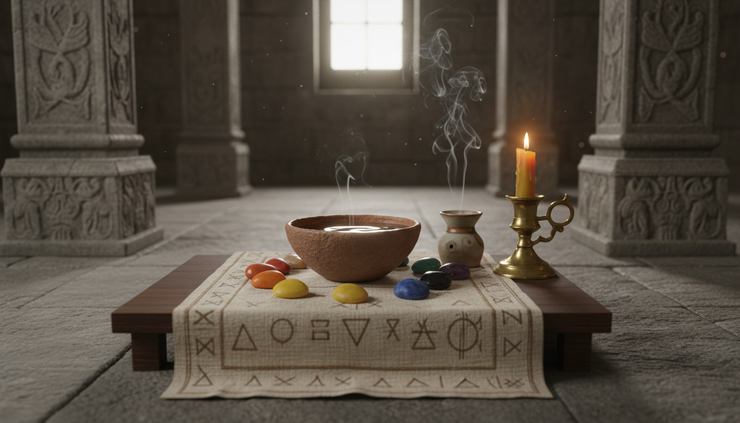
Many Hermetic systems begin with purification. This can include bathing, fasting, prayer, silence, moral reflection, or withdrawal from ordinary distractions. The goal is to clear the mind and refine intention.
In ancient religious culture, purification marked the move from ordinary life into sacred space. In Hermetic practice, it also has an inner meaning. The person tries to become clear enough to receive higher knowledge.
Purification may involve:
Washing the body before prayer or ritual
Burning incense as a sign of spiritual elevation
Reciting hymns or invocations
Avoiding anger, excess, or careless speech before sacred work
Entering a calm, focused state
The deeper idea is simple: a scattered mind cannot perceive subtle order.
Prayer and contemplation build contact with divine mind
Hermetic texts often place great value on prayer. These prayers praise the divine source, give thanks for life, and ask for illumination. They are not always petitions for worldly favors. They are acts of alignment.
Contemplation also plays a central role. A student might meditate on the structure of the cosmos, the nature of Mind, or the relationship between the soul and the divine. This is not abstract speculation alone. It is meant to transform consciousness.
In some Hermetic passages, the highest practice is inward vision. The practitioner turns away from sensory confusion and awakens to divine reality.
Astrology and planetary timing shape magical work
Astrology is one of the strongest links between Hermetic philosophy and occult practice. In traditional Hermetic and magical worldviews, the planets are not just physical bodies. They are signs of cosmic forces.
Planetary work may involve timing rituals according to planetary days and hours, using colors, metals, stones, herbs, scents, and symbols linked to a certain planetary power. For example, solar symbolism may be used for vitality, clarity, kingship, or illumination. Lunar symbolism may be linked with dreams, reflection, fertility, and change.
This does not mean every Hermetic practitioner worships the planets as gods. Some view them as living intelligences. Others see them as symbolic gateways. Still others treat them as spiritual forces within the self.
Alchemy turns matter into a mirror of the soul
Alchemy is often associated with turning lead into gold, but in Hermetic traditions it also means inner transformation. The alchemical laboratory became a symbolic theater of death, purification, union, and rebirth.
The metals, vessels, fires, and colors of alchemy could represent both physical processes and spiritual states. Lead might suggest heaviness or ignorance. Gold might suggest perfected consciousness. The philosopher’s stone became a symbol of completion.
This is one of the defining features of Hermetic occult practices: outer work and inner work reflect each other.
Theurgy seeks union with higher powers
Theurgy means “divine work.” It refers to ritual practices meant to draw the soul upward and bring it into contact with divine or angelic powers.
In late antique and later occult systems, theurgy could include sacred names, invocations, symbolic images, ritual gestures, and meditative ascent. The goal was not merely to command spirits. The higher aim was union, purification, and participation in divine order.
That separates theurgy from lower forms of magic focused only on personal gain. Hermetic theurgy asks the practitioner to become worthy of what they seek.
Hermetic deities are best understood as divine masks and cosmic powers
The question of which deities Hermeticists worship has no single answer. Hermeticism has moved through many religious settings, so its divine figures change depending on time, place, and practitioner.
In the earliest Hermetic setting, the most important divine figure is Hermes Trismegistus as revealer of wisdom. Yet he is not always worshipped like a god in a temple cult. He often appears as a teacher, sage, or inspired voice.
The deeper divine principle is the supreme God, often described as the One, the Good, the Father, or Mind. This source stands beyond images and names. It creates, sustains, and contains all things.
Other divine and semi-divine figures may appear across Hermetic and related occult systems:
Figure or power | Role in Hermetic and occult contexts |
Hermes or Mercury | Messenger, guide, patron of magic, language, and hidden knowledge |
Thoth | Egyptian god of wisdom, writing, measurement, and sacred speech |
Nous or Divine Mind | The higher intelligence through which the soul knows God |
The Sun | Symbol of illumination, life, rulership, and spiritual clarity |
The Moon | Symbol of reflection, cycles, dreams, and the subtle body |
Planetary intelligences | Powers associated with the seven classical planets |
Angels and archangels | Mediators of divine order in Jewish, Christian, and later ceremonial systems |
Egyptian gods | Used in some Hermetic and magical texts as sacred powers or symbolic forms |
The One or the Good | The highest divine source beyond ordinary description |
In Renaissance and modern Hermetic magic, practitioners often worked within Christian, Jewish, or Neoplatonic frameworks. They might invoke archangels, divine names, planetary spirits, or classical gods. In some modern occult groups, Egyptian deities such as Isis, Osiris, Horus, and Thoth became especially meaningful.
This variety can confuse people who expect one stable pantheon. Hermeticism does not work that way. It treats gods, angels, planets, and symbols as parts of an ordered spiritual universe. Different traditions emphasize different levels of that order.
The key is not the number of deities. The key is correspondence. A deity, planet, color, metal, herb, and ritual phrase may all express one pattern of power.
The uniqueness of Hermeticism lies in its blend of knowledge and transformation
Hermeticism stands apart because it refuses to separate wisdom from practice. It is philosophical, but not only philosophical. It is mystical, but not vague. It is magical, but at its best it is not merely concerned with control.
Its unique character comes from several combined traits.
It joins many traditions without becoming shapeless
Hermeticism absorbed Greek philosophy, Egyptian sacred symbolism, astrology, alchemy, Neoplatonism, Jewish mysticism, Christian theology, and later ceremonial magic. Yet it kept a recognizable center: the search for divine knowledge through the harmony of cosmos, soul, and symbol.
This ability to cross boundaries helped it survive. It could speak the language of a pagan temple, a medieval alchemist, a Renaissance philosopher, or a modern occult lodge.
It treats the human being as a small cosmos
Many traditions teach that the divine is above. Hermeticism adds that divine order is also reflected within the human being. Body, soul, mind, imagination, and spirit all become fields of sacred study.
This gives Hermetic practice a strong inner focus. Rituals are not only aimed outward. They also reorder the practitioner’s own consciousness.
It makes symbols practical
In Hermeticism, symbols are not random decorations. A planetary seal, a geometric diagram, a sacred name, or an alchemical image acts as a tool for attention and transformation.
A symbol gathers meaning. When used in ritual or meditation, it trains the mind to perceive hidden relationships.
It values direct knowledge
Hermetic texts often point toward gnosis, or direct spiritual knowing. This is not the same as collecting facts. It is a change in awareness. The student seeks to know the divine by becoming inwardly aligned with it.
That is why Hermetic writings often sound urgent. They tell the reader to wake up, remember their higher nature, and turn toward the source of life.

Hermeticism remains influential because it answers an old human question
Hermeticism asks what it means to live in a meaningful universe. Its answer is demanding but hopeful. The world is filled with signs. The soul is not trapped in ignorance forever. Through discipline, reverence, study, and inner change, a person can participate more fully in divine order.
This tradition is unique because it brings together temple religion, philosophy, ritual magic, astrology, alchemy, and mystical ascent without reducing any one of them to mere ornament. It sees the universe as alive with intelligence, and it sees the human being as capable of awakening to that intelligence.
That is the lasting appeal of Hermetic occult practice. It offers more than beliefs about hidden things. It offers a path of transformation shaped by symbols, sacred knowledge, and the search for union with the source behind all things.


Comments